Showing posts with label Essays: Philosophy. Show all posts

Monday, November 13, 2017

Tyrants turned pale.... : Studying Voltaire

Sunday morning.
My favorite time.
MY time!
Let's LEARN!

This morning I am studying the life of Voltaire. He spent decades fighting for tolerance and freedom and changed the world for the better. He fought tyranny and fanaticism and cruelty and he didn't care if his enemies were priests or bishops or aristocrats or kings he fought them all and he would never stop.

Two times he was arrested and sent to the Bastille and three times he was exiled from his homeland. Later in life he lived on the border between France and Switzerland so when the authorities came for him he could run! He would antagonize the rulers of the land with his criticisms and mockery and then, when they came for him, he would escape across the border.

Some people criticized him for running but I admire him. He was a guerrilla fighter against an oppressive government. Hit and run! We should ALWAYS hit the bad people. But then we have no obligation to let the bad people hit us back....

Voltaire was one of the most brilliant men of the 1700's and a literary genius whose pen made him the most famous man in the world and, ultimately, one of the richest.

He lived long enough to be recognized as a hero of civilization and great people from all over the world, people like Benjamin Franklin from the United States, made pilgrimages to his home to visit the giant of the age.

The French philosopher, and editor of the famous Encyclopedie, Diderot wrote of Voltaire while he was still alive: “Pile assumptions on assumptions; accumulate wars on wars; make interminable disturbances succeed to interminable disturbances; let the universe be inundated by a general spirit of confusion; and it would take a hundred thousand years for the works and the name of Voltaire to be lost.”

In the 1800's the British historian Thomas Babington Macaulay wrote: “In truth, of all the intellectual weapons that have been wielded by man, the most terrible was the mockery of Voltaire. Bigots and tyrants, who had never been moved by the wailings and cursing of millions, turned pale at his name.”

Whenever we feel grateful for being free, we should remember Voltaire.

[Read this excellent biography of the great Voltaire.]

[If you want to support "Anything Smart" just click on book links like the one below to buy your books. "Anything Smart" will receive a commission. Thanks!]

***

Copyright © 2017 by Joseph Wayne Gadway

Wednesday, June 28, 2017

Practical Thinking for Busy People

To be PRACTICAL thinkers we have to be able to make reasonably good decisions without spending 12 hours per day doing research. We have to be able to do this even in areas where we don't have expertise.

How is this possible? Even if we can't expect to make PERFECT decisions - and never make a mistake - can we at least find a way to make GOOD decisions given the very limited amount of time most of us have available for research?

Let's take a look at the Senate health care bill as an example.

To be honest I don't have time to read the Senate health care bill. To be even more honest I might not understand the bill even if I did have time to read it. Still, I feel like I have to know SOMETHING about this bill. I feel like I have to know enough to decide if I should call my Senator and say "support it" or "reject it."

So what can I do? Well, what if someone with more time and expertise than I have reads the bill and reports on it? Maybe I can rely on them.... In fact, this is exactly what the Congressional Budget Office does. I feel confident the people at the CBO are smart enough to understand this bill better than I would. Of course, the CBO might make a mistake but I certainly trust them more than I trust politicians who are arguing about a partisan political issue. So using the CBO report to help me make a decision about this bill seems like a good potential strategy.

Sadly, it turns out, I don't have time to read the CBO report either! Even more sadly, I might not have the background knowledge or expertise to even understand the CBO report. So what can I do now? Can I find someone who can read the CBO report and kind of summarize it for me?

Fortunately, many newspapers and news magazines have done just that. I will turn to a magazine I like and trust: The Atlantic. I have a reasonable level of confidence in the writers at this magazine. I think they are smart and honest so let me see what they say about the CBO report.

This is what I found in the article below which reports on the CBO report for the Senate health care bill:

  • The Senate health plan will increase the number of uninsured Americans by 22 million over the next 10 years.
  • Premiums will go up at first but then come down to less than what they are now.
  • For many people total costs will rise, however, because plans will cover less and deductibles will be higher.
  • The government will save $321 billion over 10 years. (Since the federal budget is approaching $4 trillion this means we will save less than 1% of the budget.)

https://www.theatlantic.com/politics/archive/2017/06/cbo-senate-republican-bill-22-million/531663/

Summarizing what I learned from this article I get:

  • Many more people without insurance
  • Total costs higher
  • Coverage less
  • Savings negligible...

My conclusion: BAD PLAN! Try again. So now I know I should call my Senator and say "Reject this bill!" And if he says "Why?" I even have bullet points to share and a source to reference so I don't sound like an idiot.

If I have a little more time I could read a second article in another magazine to see if it basically agrees with this one. If I wanted to be very careful I could try to read one article from a liberal magazine and one article from a conservative magazine. If they both agree on certain key points about the CBO report I can probably be pretty sure that is the truth about what is in the CBO report.

In the example I am writing about in this essay I am relying on the CBO report to help me decide whether I should support the Senate health care bill or not and I am relying on one or two news articles to help me understand what is in the CBO report.

Now I admit, if I have the time and the expertise to read the whole Senate health care bill and understand it and make a decision about it then that is what I should do. If I DON'T have the time and expertise to do that then this little essay describes a way to make a reasonable decision anyway. This "shortcut" method is not perfect but it is PRACTICAL. It is certainly better than making a decision based solely on feelings or partisan speeches, certainly better than doing nothing, certainly better than throwing up my hands in despair.

So this is what I call PRACTICAL thinking: find a source you trust and understand and that you have time to read. If you have time, check it with a second source. Look at the facts presented and make your best decision.

As a final note, keep your mind open. If someone says your decision is wrong ask them why they think that. If they have good reasons, adjust your thinking accordingly. If they don't have good reasons stick to your original decision and move on to the next issue! :-)

***

Copyright © 2017 by Joseph Wayne Gadway

***
[This looks like a great book about critical thinking. If you read it before I do please send me a review I can publish here at Anything Smart.]
[If you want to support Anything Smart just click on book links like the one below to buy your books. Anything Smart will receive a commission. Thanks!]

***

Sunday, May 28, 2017

Testing Beliefs

Good thinking is the essential foundation for all our efforts to be successful in life, to achieve our goals, to create better lives for ourselves and our families, and a better society for everyone. Whether we are choosing a mechanic to work on our car or a doctor to perform surgery, buying a house or planning for retirement, changing jobs or voting in an election, the quality of our thinking will have a lot to do with whether we succeed or fail, whether we win or lose, whether we make our lives, and our world, better or worse.

Bad thinking, on the other hand, leads to failures and foolish mistakes; it leads to missed opportunities and leaves us at the mercy of manipulators who cunningly make sure they get what they want... without any regard to what is best for us. It can even lead to injustice, or worse: as Voltaire once said, “Those who can make you believe absurdities, can make you commit atrocities.”

Learning to think better is a lifelong quest but it begins with the recognition that good thinking is important, vital to our success, in some cases even a matter of life and death, and then making a conscious effort to improve our critical thinking skills.

"Criticism is the examination and test of propositions of any kind which are offered for acceptance, in order to find out whether they correspond to reality or not. The critical faculty is a product of education and training. It is a mental habit and power. It is a prime condition of human welfare that men and women should be trained in it. It is our only guarantee against delusion, deception, superstition, and misapprehension of ourselves and our earthly circumstances."

A lot of critical thinking just comes down to asking ourselves questions about our beliefs and then trying to answer them:

  • What is it exactly that you believe?
  • Can you clearly and unambiguously define the words and phrases you use to express your belief?

  • How important is the belief?
  • Is it something very important that is worth spending a lot of time on or not? (Deciding which restaurant to have lunch at should not take much time. Deciding which house to buy should take quite a lot of time.)

  • Why do you believe what you believe?
  • Do you have strong evidence or just weak evidence?
  • Can you prove it with a logical argument? (Remember that "proof" comes in different "levels." It can be a matter of probability, or beyond a reasonable doubt, or actually certain, which will usually only happen in mathematics.)
  • Do you have to depend on expert testimony or can you analyze the evidence for yourself? (Don't be afraid to listen to experts and learn from them. That's what experts are for!)

  • Do you have time to learn more about your belief by reading articles or books?
  • How do good thinkers defend your belief?
  • How do good thinkers oppose your belief?
  • Which side has the best evidence and the best arguments?

In real life we can't always be sure we know the truth. In cases like that you don't have to be paralyzed.

  • Can you at least explain why a particular belief is beneficial to you?
  • Makes you're life better?
  • Makes society better?

If you can answer these questions in the affirmative then it is OK to keep right on believing something you can't prove. Just don't pretend your belief is based on facts and logic, admit that it is based on your faith and your values rather than some kind of proof.

Whatever else you do, keep thinking and keep learning!

***

Copyright © 2017 by Joseph Wayne Gadway

***
[This looks like a great book about critical thinking. If you read it before I do please send me a review I can publish here at Anything Smart.]
[If you want to support Anything Smart just click on book links like the one below to buy your books. Anything Smart will receive a commission. Thanks!]

***

Sunday, February 26, 2017

Learning to Think - The Eyewitness

If you want to be a good thinker you have to stretch your brain with hard problems, problems that are over your head. This problem might be over my head but I THINK I understand it:

Suppose you live in a city divided between two racial or cultural groups - we'll call them A's and B's. In this city 15% of the people are A's and 85% are B's.

There has been a crime and we have an eyewitness who says the perpetrator was an A. The police test this witness and conclude that he correctly identifies A's and B's 80% of the time.

The police chief wants to use his resources wisely so he orders his detectives to focus first on suspects who are A's....

Given that our eyewitness says the criminal is an A and the eyewitness correctly identifies A's vs. B's 80% of the time this must be a good decision, right? Or is it?

Answer below.

*

*

*

*

*

*

*

*

This is an interesting problem and one that will repay careful study. One of the most important lessons we learn from this problem is that a seemingly obvious correct answer can, in fact, be wrong.

If all we know is that an eyewitness says that an A committed the crime rather than a B, and that this witness can distinguish between A's and B's correctly 80% of the time, it seems obvious that the crime was most likely committed by an A.

But in this case we know something else: we know that A's make up only 15% of the population while B's make up the other 85%. The problem doesn't say whether A's or B's are more likely to commit crimes so, for this problem, we should assume there is no significant difference in criminal tendencies between the two groups.

***

[Check out this great book about thinking better.]
[If you want to support "Anything Smart" just click on book links like the one below to buy your books. "Anything Smart" will receive a commission. Thanks!]

***

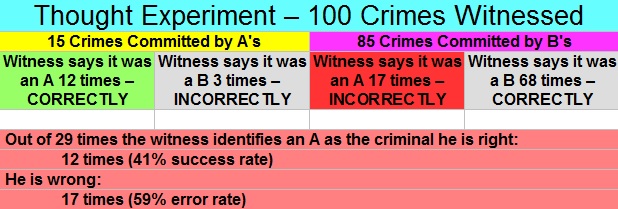
So let's do a thought experiment: let's imagine our witness saw 100 crimes rather than just one, and let's imagine that 85 of those crimes were committed by B's and 15 were committed by A's since that is the proportion we would expect to find given no difference in propensity to crime between the two groups.

If our witness saw 85 crimes committed by B's he will correctly tell us the criminal was a B 68 times but he will INCORRECTLY tell us the criminal was an A 17 times because he correctly distinguishes between A's and B's only 80% of the time.

On the other hand, if our witness saw 15 crimes committed by A's he will correctly tell us the criminal was an A 12 times and INCORRECTLY tell us the criminal was a B 3 times.

Looking at these two scenarios we notice that our witness will tell us, after seeing 100 crimes committed, that an A was the criminal 29 times even though, in reality, an A was the criminal only 15 times.

More importantly, out of 29 times our witness tells us that an A committed the crime he will be RIGHT only 12 times (41%) and WRONG 17 times (59%.)

In conclusion even though our witness has an 80% success rate of distinguishing between A's and B's and even though he identifies a particular criminal as an A it is still more likely, given the facts in this problem that the criminal was a B.

Without the eyewitness we would have have evaluated the probability of an A being the criminal at 15%. With the eyewitness the probability of an A being the criminal goes up to 41% but that is still below 50% so it would be a terrible mistake for the police chief to focus his resources on suspects who are A's. In the absence of any other evidence we have to conclude that our criminal is most likely a B.

***

When we don't understand something we tend to think about it and try to figure out.

When we ASSUME we know something we stop thinking about it, and this can result, sometimes, in tragic consequences.

It would be wise to think about things we "know" just as much as we think about things we don't know, maybe even more!

Copyright © 2017 by Joseph Wayne Gadway

Monday, February 20, 2017

The Orwellian Age of Trump

If you still care about truth this might be the most important article you read today: Why Nobody Cares the President is Lying. Conservative commentator Charlie Sykes explains how years of attacks on the main stream media have finally resulted, not just in opposition to what are considered media lies, but to a disregard for truth itself.

He writes: “For years, as a conservative radio talk show host, I played a role in that conditioning by hammering the mainstream media for its bias and double standards. But the price turned out to be far higher than I imagined. The cumulative effect of the attacks was to delegitimize those outlets and essentially destroy much of the right’s immunity to false information. We thought we were creating a savvier, more skeptical audience. Instead, we opened the door for President Trump, who found an audience that could be easily misled.”

Sykes quotes former world chess champion and now Russian political activist Garry Kasparov: “The point of modern propaganda isn’t only to misinform or push an agenda. It is to exhaust your critical thinking, to annihilate truth.”

Trump and his team are actively seeking to “annihilate truth.” When people say, “Don't take him literally, take him seriously,” when they talk about “alternative facts,” when the president tells his followers to automatically dismiss every negative poll about him as “fake news,” when he attacks the great American free press as “enemies of the people,” and when he won't even bother to tell the truth anymore about something as easily verified as which recent presidents got the most electoral votes because he knows that his followers just couldn't care less that he is lying yet again, then the destruction of truth is well under way.

When we no longer distinguish between truth and lies, when we no longer agree on the basic principles of logic, or even agree that facts are facts, then we can no longer make good decisions, we can no longer think straight about important issues, we can no longer even communicate in any meaningful way.

So what can we do to keep the truth alive in what Sykes refers to as the “Orwellian age of Donald Trump?”

These are my suggestions:

  1. Read news articles and editorials from both the right and the left. Try the National Review for conservative views and The Nation for liberal ones.
  2. Read just one article per day if that's all you have time for but don't keep reading the same side, alternate from right to left, keep exposing yourself to ideas you may not like or agree with.
  3. As you read each article try to capture the main point in a statement or sentence.
  4. If the main point is a factual statement can you verify that fact from one or two other sources? If you can't, be very cautious about accepting it. If you can, be very cautious about NOT accepting it.
  5. If the main point of the article is a statement concluding a logical argument can you you identify the premises or inputs to the argument?
  6. Once you have identified the premises can you verify they are true?
  7. If the premises are true then analyze the argument to see if the conclusion stated in the article really follows from them.
  8. If the conclusion does not follow from the premises then reject the argument. If it does, then accept the argument.
If we keep reading and thinking, about ideas we agree with as well as ideas we don't agree with we might still end up on opposite sides in political debates but at least we will be on the same side in respecting - and searching for - the truth.
***
[Check out this great new book about the 2016 election.]
[If you want to support "Anything Smart" just click on book links like the one below to buy your books. "Anything Smart" will receive a commission. Thanks!]

***
Copyright © 2017 by Joseph Wayne Gadway

Saturday, December 24, 2016

How to Deal With Biased Sources

Time is the great enemy of many things, including critical thinking. We just don't have time to think deeply about everything that crosses our path.

When it comes to the news, my opinion is that we should look at sources from the left, the right, and the center. If they all basically agree on a particular story you can be pretty confident of that information.

If they disagree on an issue that is NOT that important to you, then save your time, just accept there is a disagreement, and let it go.

If they disagree on an issue that IS important to you then GET TO WORK:

  1. Analyze the articles line-by-line.
  2. Where you find insults and jokes ignore them. They have no intellectual value unless they imply an argument in which case see below on arguments.
  3. Where you find opinions accept them as examples of freedom of speech and move on. Opinions also have little intellectual value unless they imply an argument in which case see below on arguments.
  4. Where you find factual statements verify them. Is there some authoritative source you can check? Can you check multiple sources and reach a conclusion that way? Facts are things you DO NOT argue about, facts are things you LOOK UP.
  5. Where you find arguments analyze them. What are the premises? Are they true? What is the conclusion? Does the conclusion logically follow from the premises? If yes explain why the argument is sound. If not then then expose the error in the argument. If you think you have a counter-argument construct it and share it to see if anyone can shoot it down.

What you should never, never, never do when you encounter something you disagree with is call it biased and ignore it. That is lazy and ignorant. It ensures you will not learn anything yourself and you will not help anyone else learn anything.

Thinking is important. Let's do it!

***

[Here is an excellent book on critical thinking. I hope you will buy it and hone your skills.

If you want to support "Anything Smart" just click on book links like the one below to buy your books. "Anything Smart" will receive a commission. Thanks!]

Copyright © 2016 by Joseph Wayne Gadway

Monday, December 19, 2016

Dealing With Our Irrational Minds – What's Your REAL Reason?

Some people seem to be irrational almost ALL of the time. Even people who are EXTREMELY rational SOME of the time are still irrational MUCH of the time.

I am no exception. I have to admit I often buy groceries based on which packaging appeals to me more. I'll buy something with a picture of a tiger on it, or a tree; before something with a kitten, or a flower. That's not very rational but that's what I do in the absence of other, overriding information.

In a way we have to do this. We don't have time in life to think hard and deep and do detailed research and analysis every time we make a decision.

So on minor decisions, go ahead and revel in your irrationality and go with your instincts or feelings and do what you want and don't worry about it.

Most people would agree, though, that on very serious decisions, with potentially serious consequences, we should be more careful in our decision making; we should be more rational.

A presidential election is very serious and certainly if we ever need to be rational it is when deciding who to vote into the White House. But how do we know if we are being rational? Maybe I don't like Trump because he wears his ties too long, or because his hair is... well... like THAT, or because a teacher criticized me in 2nd grade and Trump's nose reminds me of that teacher. Maybe one of these possibilities is the REAL reason I dislike Trump and maybe all my rational sounding explanations and arguments are just excuses and covers for that REAL reason.

Now first I want to say that I am being very serious here. I am not making up ridiculous examples. I think many important decisions in life are based on subtle, almost subconscious, reasons just like these.

I have noticed many times that if someone says I believe in A because of reason X and then you disprove X the person will say oh wait, the real reason I believe in A is because of Y, and then if you disprove Y the person will say oh wait, the real reason I believe in A is because of Z.... And so on.

The truth is they may not even know WHY they believe in A. They just believe in A for SOME reason but all the stated reasons are not the real reason, they are excuses or covers for the real reason.

A person might say they have three reasons any one of which justifies belief in A. That's fine. But if we disprove all three of those reasons and then they shift to other reasons we are in the same position we described in the preceding paragraph. It seems the person we are talking to is not giving us REAL reasons.

Sometimes these people may actually know the real reason they believe in A and not want to say it. Maybe it is embarrassing or socially unacceptable in some way. But at other times I think these people really DO NOT KNOW why they believe A. They just do.

I do not criticize this second group of people. They are following subconscious urges, as we all do, and trying to provide rational justification for their beliefs and actions, as we all do. They are just failing to get at the REAL reason, or even an ADEQUATE reason.

Now we get to the point of this little essay. I oppose Trump very strongly. It is POSSIBLE that my REAL reasons are buried deep within my subconscious and I don't even know what they are. It is POSSIBLE that something about Trump, maybe some gesture he makes, reminds me of the 4th grade teacher who infuriated me by making me stand in the corner.

If this is true, if my real opposition to Trump is based on one or more long-buried memories in my subconscious then I may NEVER know the REAL reason I oppose Trump. That is a possibility I have to accept.

But we still have to make decisions in life and in serious cases we need to be rational so what can we do?

Even if there are cases where we cannot be sure what the REAL reason is for our beliefs and actions we can still make sure we have an ADEQUATE reason.

An adequate reason is one that is strong enough to explain our belief or action, and that rationally justifies our belief or action, even if the REAL reason is something different that we don't even know or understand.

An adequate reason is also one that we are willing to apply to everyone, no matter who they are or what party they belong to or what our instincts and feelings tell us about them.

Here is an example. Why do I oppose Trump? I will answer in the form of a syllogism:
No one without government experience should be president.
Trump has no government experience.
Therefore, Trump should not be president.

And here is a second argument:
No one who praises dictators should be president.
Trump praises dictators.
Therefore, Trump should not be president.

If I say that these are the reasons I oppose Trump then if someone can disprove them I should stop opposing Trump. If these arguments are disproved and I stop supporting Trump then I can argue that my position is rational even if I don't know the REAL or subconscious motivations behind it.

If someone disproves these reasons and I continue to oppose Trump then either I am not being rational or, at very least, I have so far failed to prove my rationality.

One last point – the first line in each of my arguments is actually a value judgment rather than a statement of fact. Value judgments cannot be proven either true or false so maybe this is just another trick to support my irrational choice and prevent anyone from exposing my irrationality?

In the case of arguments involving value judgments we can demonstrate we are being rational by using the same standard to judge everyone. For example, if the Democrats nominate someone in 2020 and that person has no government experience or praises dictators and if I, nevertheless, support them, then you will know that my stated reasons for opposing Trump were neither REAL nor ADEQUATE.

If, on the other hand, I oppose that nominee in 2020 then that will provide support for the conclusion that my reasons are both rational and ADEQUATE, whether or not they are REAL which, perhaps only years of psychotherapy could determine.

***

[Here is an excellent book on critical thinking. I hope you will buy it and hone your skills.

If you want to support "Anything Smart" just click on book links like the one below to buy your books. "Anything Smart" will receive a commission. Thanks!]

Copyright © 2016 by Joseph Wayne Gadway

Monday, September 5, 2016

Intellectual History

If I could only study one subject for the rest of my life it would be intellectual history. That's kind of cheating because when you study intellectual history you still reserve the right to poke your nose into almost everything human  beings have ever done.

You take anything that people know, or think they know, and trace the steps by which that knowledge was gained. You take any idea and study how that idea was first glimpsed and how it developed, over years or over centuries, and how it interacted with, supported, or conflicted with, other ideas.

What do we believe? Where did those beliefs come from? How did they come to be accepted? How have they influenced individual lives and societies for better or worse? How well supported are the beliefs that people live by and die for and argue about on Facebook?

That's my favorite subject....

***
[Peter Watson's book "Modern Mind" is one of the great works of Intellectual History. This is a college education in one book!

If you want to support "Anything Smart" just click on book links like the one below to buy your books. "Anything Smart" will receive a commission. Thanks!]


***